
HDR Project
Who Counts as a Caregiver? A Dual-Axis, AI-Enhanced Model of Support in Asian Familistic Contexts
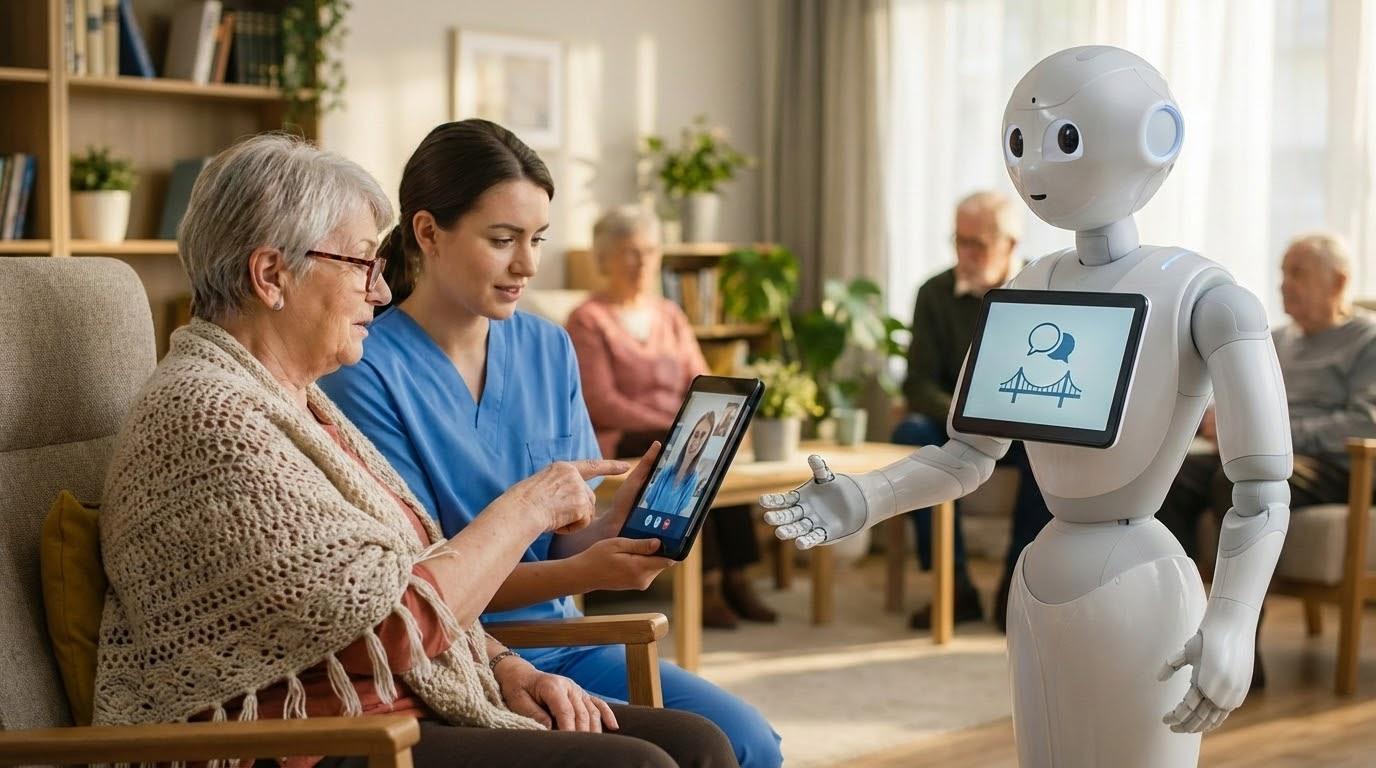
Build a dual-axis, AI-enhanced model of caregiving engagement that integrates identity recognition, love-duty negotiation, individual readiness, collective family readiness, and predictive risk into one decision-support framework.
1Research story
Research context & significance
In Singapore, 1 in 3 caregivers lives with 2 or more chronic conditions — yet many remain invisible to the very systems designed to help them. Existing frameworks assume that needs lead to action. They ignore identity ("I don't call myself a caregiver"), emotional readiness ("I'm not ready to accept help"), family disagreement, and the love-duty negotiation that shapes Asian caregiving. Foreign domestic workers, young carers, and non-self-identifying caregivers fall through the cracks. The result: services exist, but they do not reach the people who need them most.
Create the missing integration layer: predictive risk + emotional readiness + cultural context + family dynamics + human-in-the-loop decision support. This is not another caregiver burden survey or another chatbot. It is a fundamentally different way of asking the question — moving from "Why don't caregivers use services?" to "What would it take for support to be genuinely receivable?" The measure of success is not enrolment numbers. It is how many caregivers feel genuinely supported — and how few are left invisible.
Research questions & objectives
- Build a dual-axis, AI-enhanced model of caregiving engagement that integrates identity recognition, love-duty negotiation, individual readiness, collective family readiness, and predictive risk into one decision-support framework — so that support reaches caregivers at the right time, in the right way, without eroding dignity or adding to their burden.
Research approach
A · Input / Context
Caregiver narratives and conversational text. Support group messages. Family chat logs (with consent). Validated scales (ZBI, PHQ-9, GAD-7). Multilingual inputs from FDWs — Singlish, Bahasa Indonesia, Tagalog, Burmese. The voices that surveys miss.
B · Method / Process
LLM-based risk detection and readiness inference. Two-tier readiness architecture: Brown's six macro identity stages + Transtheoretical Model micro states. Love-duty language pattern detection. Deterministic safety gate for crisis. Human-in-the-loop dashboard for community nurses and social workers. AI as listening infrastructure — never as authority.
C · Evaluation / Validation
Compare 4 conditions: survey-only (current standard) vs. AI-enhanced continuous monitoring, human-only case management vs. integrated human-in-the-loop model. KPIs incl. readiness-aligned uptake, time-to-uptake after risk detection, concordance with validated clinical scales, false alarm rate, dignity and equity audit, and caregiver-reported experience. Success is measured not only in efficiency but in whether caregivers feel seen, respected, and supported in a way that fits their life and their values.
Expected outcome
A validated dual-axis model and 5-layer decision-support architecture that helps frontline workers reach invisible caregivers, time support to readiness rather than crisis, and measure what matters: dignity, equity, and genuine care benefit. A policy brief for MOH and Healthier SG. A practical tool co-designed with social workers, case managers, and caregivers themselves.
2Progress & key evidence
Progress since last update
- Conceptual synthesis explored across caregiving science, health services research, social psychology, migrant labour studies, and human-AI interaction
- Research gap identified and articulated: most models treat risk, identity, readiness, and family context as separate problems. Dual-axis model specified. 2-tier readiness architecture developed (Brown's macro stages + Transtheoretical micro states)
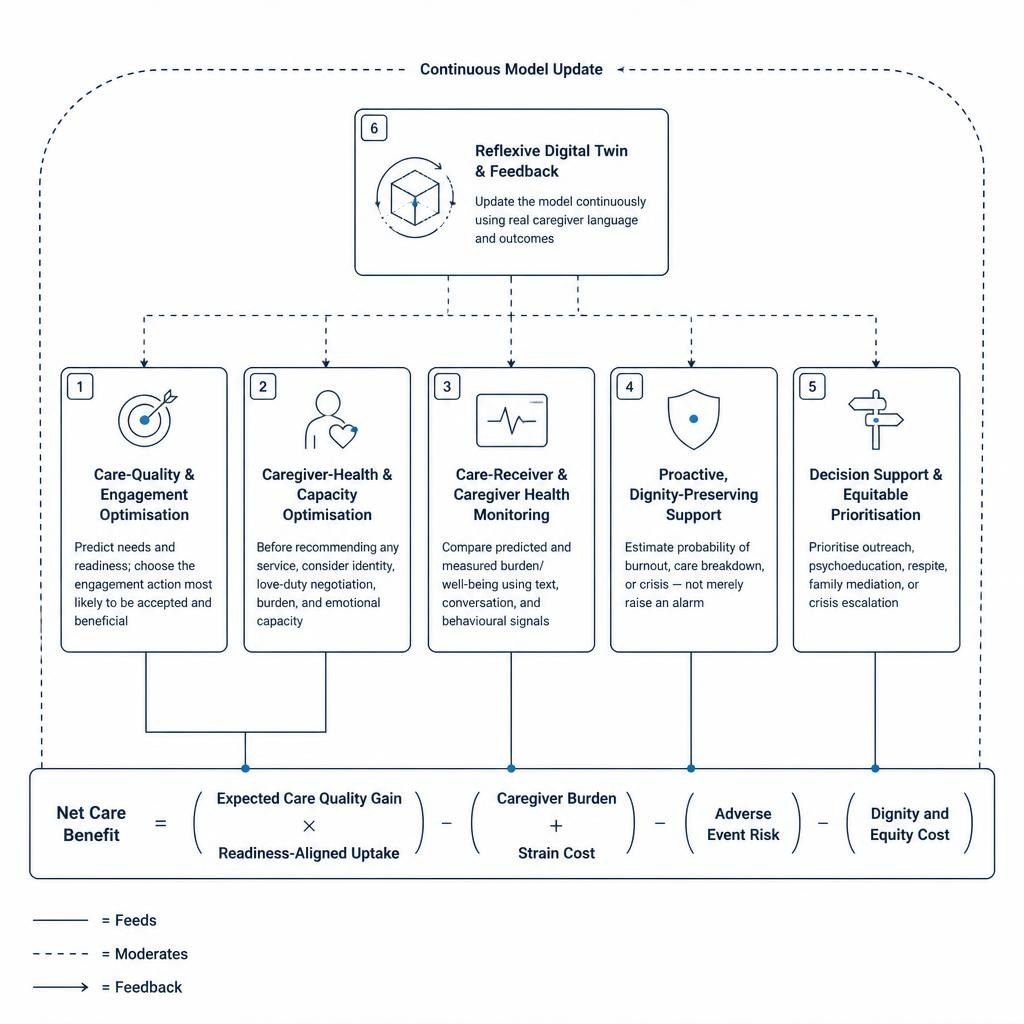
- 5-layer computational architecture proposed with deterministic safety gate and human-in-the-loop dashboard. 7-paper research agenda with dual-domain deliverables mapped
Tangible outputs & evidence
- Paper 1 draft: Conceptual synthesis, dual-axis model, 2-tier readiness architecture, 5-layer system architecture, objective function, and 7-paper agenda
Key result
- The goal is not service uptake for its own sake, but net care benefit of timely, readiness-aligned, dignity-preserving, equitably distributed support.
- A caregiver who declines help is not a failure of uptake – it is a signal to listen differently.
What should we notice?
- The research gap is not another caregiver burden survey or another chatbot. It is joint decision-making across risk, identity, readiness, and family context. AI is not the intervention – it is the listening infrastructure that makes support receivable.
One-sentence takeawayWe cannot support caregivers until we ask who counts as one – and until our care ecosystem learn to listen before they prescribe
3Next steps, risks & support
Next steps
- 1
Finalise the integrated framework overview and objective function for Paper 1
15 Oct 2026
- 2
Draft the 2-tier readiness architecture and 5-layer system specification for Paper 1
31 Oct 2026
- 3
Complete Paper 1 manuscript for supervisor review
30 Nov 2026
Success by next forum: Complete draft of Paper 1 + Operationalisation blueprint for Paper 2
Risks & blockers
- Access to multilingual caregiver data – particularly FDW languages and Singlish – may be challenging
- Ethical approval for conversational data collection requires careful design to protect vulnerable populations. AI safety concerns in clinical contexts require robust safeguards from day 1.
- Balancing the Computer Science slant Social Work depth in Paper 1 requires careful calibration.
Support needed
- Seeking supervision on CS rigour and balance to social work depth here. Confirmation that the integrated framework architecture meets milestone expectations
Possible Research Grants (Proposed)
- NCSS Transformation Sustainability Scheme
- IMDA SG Digital Scholarship (Postgraduate)
Final take-awayThis thesis is not about building another algorithm. It is about building a listening infrastructure – one that reaches the caregivers who never raise their hand, times support to readiness rather than crisis, and measures success not in uptake, but in dignity. We cannot support caregivers until we ask who counts as one.
Research team
Don Tan
HDR Candidate

Dr Jaideep Chandran
Principal Supervisor
Related projects
All projects→ Active
Emerging Technologies
A Self-Adaptive Digital Twin Software Architecture for Autonomous PV Asset Management and Decision Orchestration
How can a PV Digital Twin automatically adapt its software, models, and computing resources to manage PV assets reliably with minimal human intervention?
 Active
Emerging Technologies
Real-Time Predictive Analytics for Proactive Wealth Management Interventions
Design, implement and evaluate a real-time predictive analytics framework that continuously monitors portfolio and client signals and turns emerging risks or opportunities into timely, explainable, human-supervised wealth-management interventions.