
HDR Project
A Self-Adaptive Digital Twin Software Architecture for Autonomous PV Asset Management and Decision Orchestration
How can a PV Digital Twin automatically adapt its software, models, and computing resources to manage PV assets reliably with minimal human intervention?
1Research story
Research context & significance
Existing PV Digital Twins can monitor, predict, and control system behavior, but they often cannot adjust how their software works when operating conditions, computing resources, or system needs change. This research addresses how a PV Digital Twin can automatically adjust its models, services, and computing resources so that it can manage PV assets reliably with less human intervention.
A new self-adaptive software architecture that enables PV Digital Twins to manage assets more autonomously, reliably, and efficiently.
Research questions & objectives
- How can a PV Digital Twin automatically adapt its software, models, and computing resources to manage PV assets reliably with minimal human intervention?
Research approach
A · Input / Context
PV system data and operating conditions. Sensor data, weather data, PV asset status, network conditions and computing resources.
B · Method / Process
Develop a self-adaptive Digital Twin architecture. Build a prototype that can monitor conditions and automatically adjust its models, services, workflows and computing resources.
C · Evaluation / Validation
Evaluate using PV scenarios and compare with a non-adaptive Digital Twin based on reliability, response time, accuracy and resource use.
Expected outcome
A prototype for more reliable and autonomous PV asset management.
2Progress & key evidence
Tangible outputs & evidence
- Systematic Literature Review
Key result
Research Gap Identification
- 864 unique papers identified for PRISMA screening
- 127 papers identified as directly relevant/high-priority
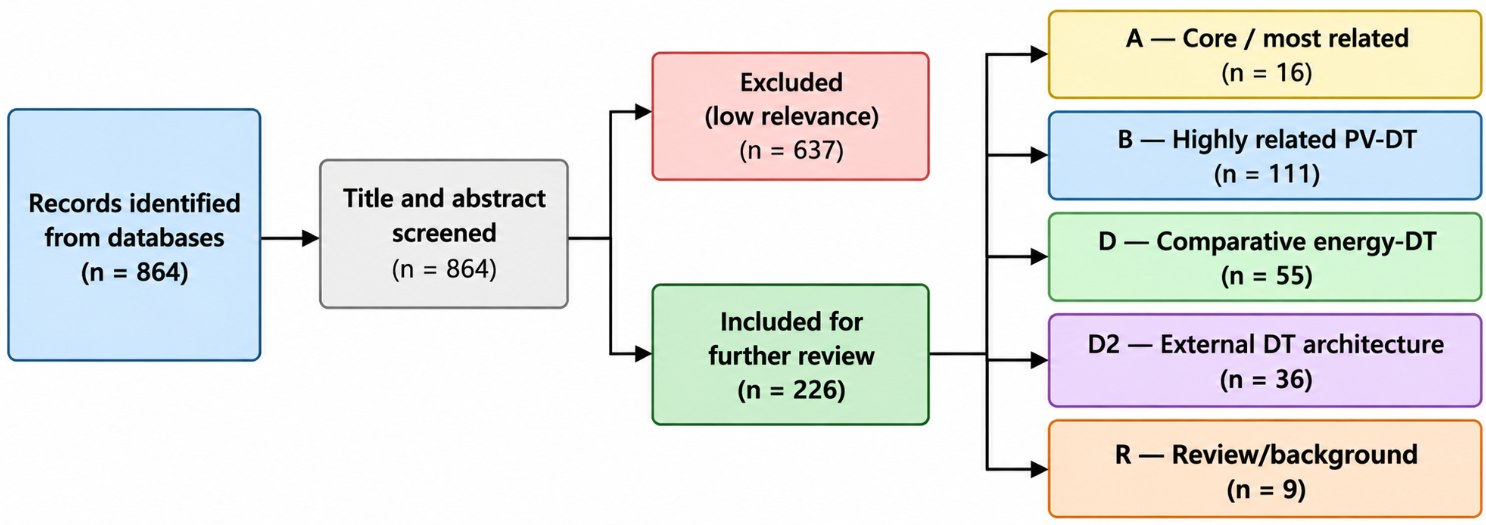
What should we notice?
- Interpretation: A lot of paper to read
- Why it matters: Solidify research gap
One-sentence takeaway226 were retained as relevant, showing that while Digital Twin research is extensive, only a smaller subset directly informs PV-focused, self-adaptive, and software architecture research.
3Next steps, risks & support
Next steps
- 1
Complete PRISMA Title and Abstract Screening
05/10/26
- 2
Full-Text Review
16/10/26
- 3
Initial Research-Gap Analysis
26/10/26
Risks & blockers
- Volume of Literature for full-text assessment
- Complexity of defining and classifying Digital Twin concepts
Questions for discussion
- Should the review focus primarily on PV Digital Twins, with other energy domains used only to address gaps in the PV literature?
Final take-awayThe research is currently reviewing existing Digital Twin literature to identify key gaps, with the next step being to finalize the systematic literature review.
Research team

Khanh Huynh
HDR Candidate

Dr Jaideep Chandran
Principal Supervisor
Related projects
All projects→ Active
Emerging Technologies
Real-Time Predictive Analytics for Proactive Wealth Management Interventions
Design, implement and evaluate a real-time predictive analytics framework that continuously monitors portfolio and client signals and turns emerging risks or opportunities into timely, explainable, human-supervised wealth-management interventions.
 Active
Emerging Technologies
Who Counts as a Caregiver? A Dual-Axis, AI-Enhanced Model of Support in Asian Familistic Contexts
Build a dual-axis, AI-enhanced model of caregiving engagement that integrates identity recognition, love-duty negotiation, individual readiness, collective family readiness, and predictive risk into one decision-support framework.