
HDR Project
Autonomous PV Asset-Health and Energy-Yield Optimization System
Build an autonomous controller that jointly optimizes panel position, PV health, tracker health, weather risk and maintenance priority to improve net energy and reliability.
1Research story
Research context & significance
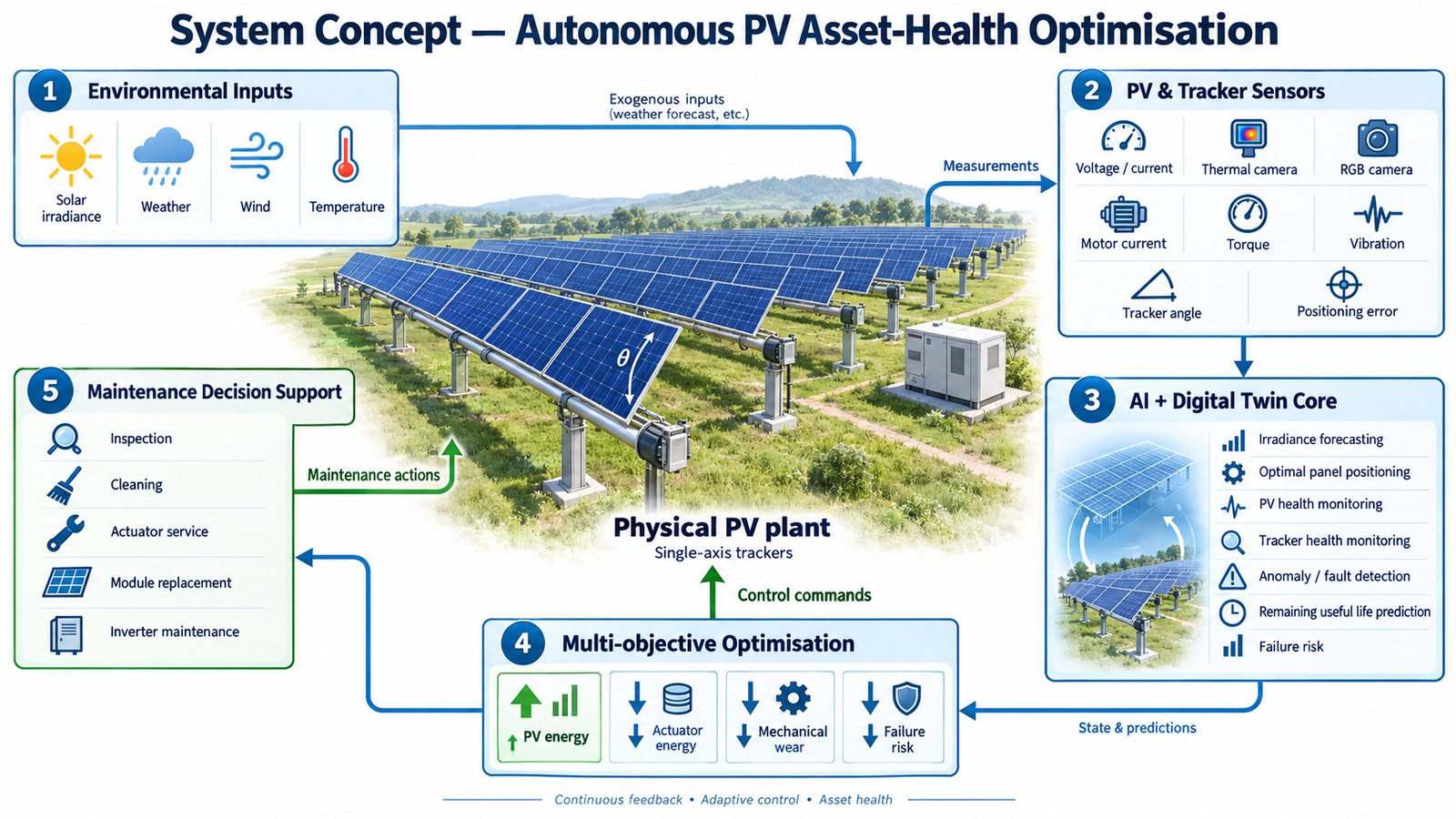
PV tracking, energy optimization, fault diagnosis and maintenance are often handled separately. That can improve irradiance capture while overlooking actuator energy, wear, misalignment and failure risk.
Create the missing integration layer: forecasting + health monitoring + predictive maintenance + maintenance decision support in one continuously updated PV-field control framework.
Research questions & objectives
- Build an autonomous controller that jointly optimizes panel position, PV health, tracker health, weather risk and maintenance priority to improve net energy and reliability.
Research approach
A · Input / Context
Weather/irradiance, electrical telemetry, inverter data, RGB/IR imagery, and tracker sensors: position, motor current, torque, vibration and temperature.
B · Method / Process
AI forecasting and fault/health models feed a health-aware tracker controller. The controller trades energy gain against actuator energy, wear and failure risk.
C · Evaluation / Validation
Compare fixed PV, a conventional tracker and AI health-aware control. Measure net energy, tracking error, fault metrics, maintenance lead time, loading, availability and LCOE impact.
Expected outcome
A prototype decision framework/digital twin that co-optimizes energy yield, asset health and maintenance actions using feedback from actual field behaviour.
2Progress & key evidence
Progress since last update
- Integrated research scope defined across energy optimization, tracker health, PV fault detection and predictive maintenance.
- Literature maturity/gap mapped: diagnosis is mature, true RUL prediction is less mature, and integrated optimization remains emerging.
- Validation comparison and KPI set specified for fixed PV vs conventional tracking vs AI health-aware control.
Tangible outputs & evidence
- Paper 1 systematic-review scope, research gap and evaluation framework defined
Key result
What should we notice?
- The research gap is not another tracker or fault detector; it is joint decision-making across energy and asset health.
- Tracker movement is worthwhile only when expected energy gain exceeds actuation, wear and failure-risk costs.
- The target is higher net yield and reliability, not maximum irradiance capture alone.
One-sentence takeawayMaximise Net Benefit = Expected PV Energy − Actuator Energy − Expected Wear Cost − Failure Risk
3Next steps, risks & support
Next steps
- 1
Finalize SLR protocol, databases, search strings and inclusion/exclusion criteria.
05 Oct 2026
- 2
Run literature search, de-duplicate results and begin screening across the review themes.
15 Oct 2026
- 3
Draft evidence synthesis, research-gap statement and joint-optimization conceptual framework.
25 Oct 2026
Success by next forum: SLR evidence map + conceptual framework ready
Risks & blockers
- Scope may become too broad across tracking, weather, PV faults, tracker mechanics and maintenance.
- Synchronized electrical, weather, imagery and tracker-condition data may be difficult to access.
- Phase the work: SLR → subsystem models → integrated controller; validate with benchmark/simulated data before field deployment.
Support needed
- Supervisor feedback on scope boundaries and SLR protocol; guidance on representative PV/tracker datasets or field access.
Possible Research Grants (Proposed)
- NRF Competitive Research Programme (CRP)
- MOE Academic Research Fund Tier 2
- AI Singapore — Research / Technology programmes
Final take-awayThis stage is defining and de-risking a joint optimization problem connecting PV yield, tracker health and predictive maintenance before integrated prototype development.
Research team

Venuka Wijeyaratne
HDR Candidate

Prof Alex Stojcevski
Principal Supervisor
Related projects
All projects→ Active
Sustainability & Energy
Circular Practices in Action: A Practice-Based View of Collaboration in Singapore’s Seafood Ecosystem
Explore how collaborative practices support the implementation of circular economy practices within Singapore’s seafood ecosystem.
 Active
Sustainability & Energy
Responsibility for Climate-Related Disclosure (CRD) in Singapore: Is the Legal Framework Effective to Achieve Singapore’s Carbon Emission Target?
How does Singapore’s CRD compare with the European Union’s and Australia’s CRDs?