HDR Project
Nurses’ experiences on patient safety culture working in Nursing Homes in Singapore: an explanatory sequential mixed-methods study
The purpose of this study is to explore and understand registered nurses' experiences of patient safety culture (PSC) from the nursing homes setting in Singapore.

1Research story
Research context & significance
Promoting patient safety culture is essential to quality care. Given nurses’ central role, a mixed methods research is needed to explore their experiences of safety culture in Singapore nursing homes, where there is a paucity of such studies.
This study advances understanding of patient safety culture in Singapore nursing homes, identifies improvement opportunities, and informs policies and strategies to strengthen nurses’ commitment, safety practices, and supportive working environments.
Research questions & objectives
- The purpose of this study is to explore and understand registered nurses' experiences of patient safety culture (PSC) from the nursing homes setting in Singapore.
Research approach
A · Input / Context
Patient safety culture in Singapore nursing homes remains underexplored. The study examines registered nurses’ experiences, perceptions, attitudes, roles, and factors influencing patient safety practices.
B · Method / Process
An explanatory sequential mixed-methods design uses the NHSPSC Version 2.0 survey first, followed by semi-structured interviews to explain quantitative findings, guided by the Theory of Planned Behaviour.
C · Evaluation / Validation
Findings are strengthened through mixed-method triangulation, a validated survey, supervisor-reviewed interview questions, pilot interviews, member checking, reflexivity, audit trails, thick description, and supervisory verification.
Expected outcome
Findings will enhance understanding of nursing-home patient safety culture, identify enabling and hindering factors, and inform recommendations for administrators and policymakers to strengthen safety culture and nurses’ commitment.
2Progress & key evidence
Progress since last update
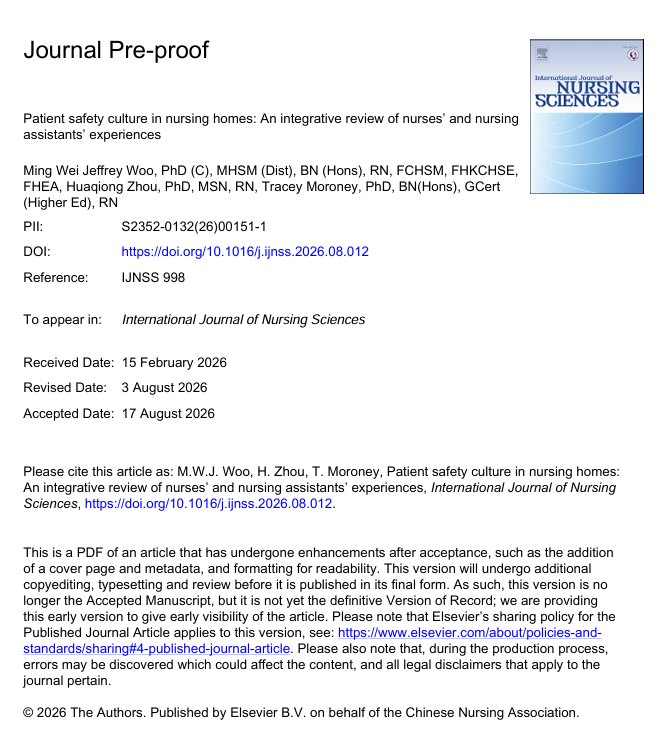
- Completion and publication of Integrative Review at the International Journal of Nursing Sciences (Elsevier), Q1 Journal, Impact Factor 4.4
- Completion of Chapter 1 and 2 of the PhD Thesis and halfway completion of Chapter 3 (Methodology)
- Pilot Interview (3 rounds) with PhD Supervisors. Preparing for actual fieldwork and data collection.
Tangible outputs & evidence
- Paper 2 & 3: Reporting the key findings from the qualitative interviews
- Woo, M. W. J., Zhou, H., & Moroney, T. (2026). Patient safety culture in nursing homes: An integrative review of nurses’ and nursing assistants’ experiences. International Journal of Nursing Sciences. https://doi.org/10.1016/j.ijnss.2026.08.012
Key result
- Future qualitative or mixed-methods studies should explore registered nurses’ perceptions and explain how organisational, relational, and systemic conditions influence safety intentions, behaviours, and patient safety culture.
What should we notice?
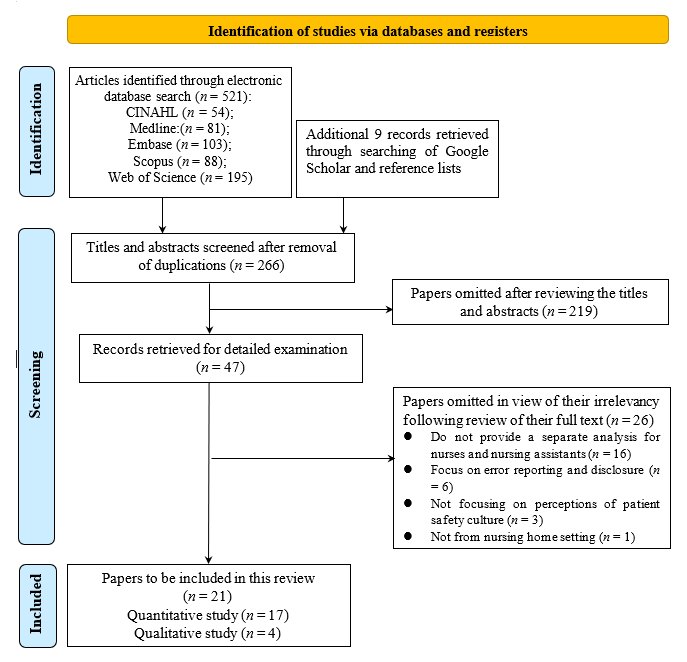
- Across 21 studies, nursing professionals reported moderately positive patient safety culture, yet important safety areas required improvement, with registered nurses reporting less-positive perceptions than other nursing professionals.
- Positive safety beliefs and intentions did not consistently translate into practice; relational, structural, organisational, and management conditions influenced nursing professionals’ commitment to patient safety.
- Singapore evidence remains limited; one identified cross-sectional study assessed safety culture in only two nursing homes, supporting broader research specifically examining registered nurses’ perceptions.
One-sentence takeawayInsights into RNs’ experiences of PSC is needed to assessing and enhancing their commitment to promoting a just and safe culture in the nursing home.
3Next steps, risks & support
Next steps
- 1
Presentation for Integrative Review at the Sigma Asia Regional Nursing Conference (awarded for oral presentation).
27 Oct 2026
- 2
Continue to write-up Chapter 3 of the thesis (Methodology Chapter) and revise and refine interview questions following pilot interviews
15 Oct 2026
- 3
Draft up revised research proposal and necessary documents for submission to the Curtin Human Research Ethics Committee (HREC) for amendment.
5 Oct 2026
Success by next forum: Integrative Review, Methodology Chapter, Preliminary Results, Candidature Report
Risks & blockers
- Recruitment of potential participants to take part in the survey and one-to-one interview.
- The quality of interview data (richness) to achieve data saturation.
- The availability of software to facilitate data collection and analysis.
Support needed
- Supervisors’ feedback on the methodology (Chapter 3 of the PhD Thesis), scope boundaries and fieldwork data collection.
Possible Research Grants (Proposed)
- Sigma Nursing Small Grants (Sigma Theta Tau International Honor Society of Nursing)
- Curtin University Higher Degree by Research (HDR) Engagement Grant (Awarded)
Acknowledgement
- Curtin Overseas Postgraduate Research Scholarship (COPRS)
- Curtin University Higher Degree by Research (HDR) Dissemination Grant
Final take-awayThe findings of this study are envisaged to add to the body of knowledge to better understand the current patient safety culture situation in Singapore nursing homes. Such information is vital to inform nursing home administrators and health policy makers in Singapore to devise interventions and make recommendations to enhance the overall institutional safety culture of the nursing homes and improve nurses’ commitment to patient safety.
Research team

Woo Ming Wei Jeffrey
HDR Candidate

Dr Zhou Huajiong (Jo)
Principal Supervisor